After a while, they open up.
Since 2017, art therapist Martina Dresler has been offering art therapy to patients at Felix Platter Hospital in Basel. She has achieved remarkable results.
How long has art therapy been available at Felix Patter Hospital, Ms Dresler?
I have been organising art therapy since 2017. It was initiated by Prof. Dr Reto W. Kressig, Medical Director of Felix Platter. The most severe cases with advanced dementia, with an MMSE below 13, are often lost causes because they are so cognitively impaired that they cannot participate in normal therapies. We then started a pilot project to paint with these patients.
What results have you achieved?
We observed remarkable developments. For example, many patients became much calmer and suddenly even began to speak again. Over time, many became increasingly motivated and their self-confidence was clearly strengthened. How can this be explained? The special thing about art therapy is that it reaches dementia patients on an emotional level. They can make use of their non-verbal and pre-cognitive abilities and thus discover resources that make them feel valuable and useful again. Being able to express oneself through an artistic medium has a positive effect on quality of life. The decline in mental abilities temporarily recedes into the background; it becomes irrelevant when painting.
Is this more of a short-term behavioural change?
The results are not permanent; of course, we cannot cure dementia with art therapy. Especially in severe cases, the aim is to give them a moment of relief and let them relax for an afternoon. Simply to have a good time.
And because this project was so successful, it was continued?
Yes, exactly. I now do the therapy twice a month, always at the weekend. There is usually less going on than during the week and boredom can set in. I then organise the afternoon and, incidentally, I don't refer to it as therapy at all.
Why not?
When the word therapy is mentioned, patients think they have to perform. For many, this often leads to defensive behaviour and refusal. That's why we just call it: surprise afternoon with coffee.
Wouldn't it make sense to hold the ‘surprise afternoon’ more than twice a month?
That would be desirable and more effective. However, patients are only hospitalised for a short time. This means that in 70 per cent of cases, I only paint with the patients once anyway. Only if they have a longer stay can I work with them more regularly.
Tell us what a typical afternoon is like.
We meet around a large table, which is also covered with painting supplies, and drink coffee. I talk a lot with the course participants and ask them about their past experiences. We actually talk to each other about private matters in a completely normal way. At the same time, we not only have the painting supplies on the table, but also other activities. For example, school modelling clay or tile-laying games with different graphic shapes and colours. I have old photos from the charity shop showing weddings or children that people can look at, which often leads to conversation. And a Russian babushka doll that you can take apart and put back together again. It's very important that the table is always colourful, as this seems to make everything more attractive.
Do all patients really have a positive attitude towards these activities?
Women who have painted before are particularly happy to have brushes and paper, and some paint with intense concentration for over two hours. But with men in particular, it happens that they have probably never painted in their lives, perhaps not even as children. Then they sit here at first and say they don't want to do it. It's important not to push them, to give them time. Sometimes modelling clay helps; they can do something with their hands, which calms them down. But there are also patients who just sit there and don't want to do anything. That's when the mirror neuron effect often comes into play.
You'll have to explain that.
When you observe someone doing something, you do it in your head through observation. The activities are reflected in your head. I have found that it often takes up to an hour for these people to give up their resistance and then join in. That means they observe what is happening very closely for a while and then pick something up. Sometimes they sort the shapes, which is very popular. It's similar with talking. It takes time for individuals to start talking. Some patients remain inactive the whole time, but by observing and listening to the others, they too calm down.
So a kind of group dynamic develops?
Exactly. We had a special case recently. It turned out that one patient used to be a musician. We have a piano here in the room. I had to persuade him a little, but in the end he sat down at the piano and played for all of us. It created a wonderful atmosphere.
Have you changed anything in the therapy over the last five years?
I changed the size of the paper, I made it smaller. Because I had the impression that large sheets of paper tended to intimidate people and make them fear that they wouldn't be able to cope. But A5-sized cardboard works wonderfully. And over time, I added the modelling clay and tile games I mentioned earlier. Viseur is a game that was originally developed for children. It consists of plastic tiles in different colours, which contain basic shapes such as circles, squares, rectangles and triangles. Interestingly, those with less severe cognitive impairments form these tiles into patterns that resemble the basic shapes. Those with more severe impairments tend to sort them, putting all the triangles in one pile or all the red shapes in another.
What do the participants actually draw?
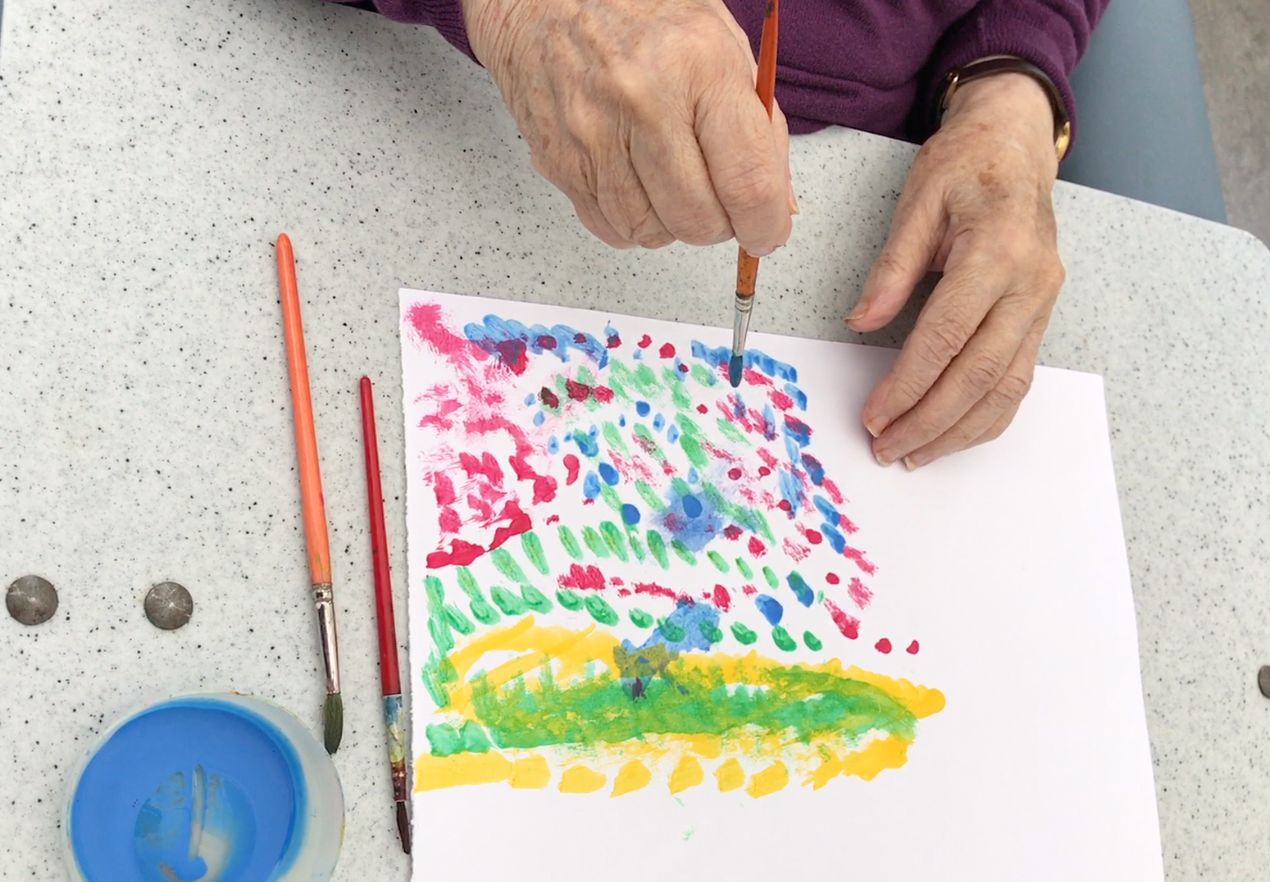
I recently had a man who sat in his wheelchair completely lost in thought. He didn't talk, and it was impossible to even make eye contact with him. I gave him a paintbrush and some paper, and suddenly he dipped the brush in the paint himself and began to paint spots. The patients don't paint illustrative pictures. They tend to paint primitive forms of children's art, such as circles, spots, spirals and dots. Only those who are less severely impaired sometimes paint a tree or a bird. In another case, a woman with whom it was no longer possible to communicate verbally painted dots on paper to the beat of the music that I usually play in the background. I have found that even with severe cases, it is possible to communicate with them through kindness and openness. They seem to sense the energy and goodwill, and over time they open up – each in their own way. Many also thank me for the lovely afternoon. It is amazing and touching what I experience there time and time again.
Article in the newsletter >Homes & Hospitals<
Author: Florian Fels
Published: 5 August 2022
Martina's Blog